

A logo alone does not create a strong brand.
In today’s competitive digital world, businesses need a consistent brand identity across their website, social media, advertisements, presentations, packaging, business cards, and every other customer touchpoint.
This is where brand guidelines become essential.
Brand guidelines provide a clear set of rules that explain how a company should present its brand visually and communicate with its audience. They help businesses maintain consistency, build recognition, and create a professional image.
In this guide, we will explain how to create brand guidelines, what they should contain, and why every growing business should have them.
What Are Brand Guidelines?
Brand guidelines, also known as a brand style guide, are a document that defines how a company’s brand should be used and presented.
T
They establish rules for important brand elements such as:
- Logo usage
- Brand colors
- Typography
- Photography
- Graphic design
- Icons and illustrations
- Social media designs
- Marketing materials
- Tone of voice
- Brand messaging
Think of brand guidelines as the instruction manual for your brand.
Whenever a designer, marketing team, social media manager, advertising agency, printer, or developer creates something for your company, they can refer to the guidelines to ensure everything looks and feels consistent.
Why Are Brand Guidelines Important?
1. They Create Brand Consistency
Imagine visiting a company’s website and seeing one color scheme, then visiting its Instagram page and finding completely different colors, fonts, and designs.
It can make the company look unprofessional.
Brand guidelines ensure that your visual identity remains consistent across all platforms.
Your:
Website → Social Media → Ads → Brochures → Presentations → Business Cards → Videos
should all feel like they belong to the same company.
Consistency makes your brand easier to recognize and remember.
2. They Build a Professional Brand Image
Customers often judge a business by its presentation.
A consistent visual identity communicates:
- Professionalism
- Reliability
- Attention to detail
- Trust
- Quality
A well-designed brand can make even a growing business appear more established and credible.
3. They Improve Brand Recognition
Strong brands are recognizable even before customers read their name.
Think about how easily people identify major brands through their colors, typography, logos, packaging, or visual style.
This recognition doesn’t happen by accident.
It comes from consistent brand application over time.
Brand guidelines help businesses establish that consistency.
4. They Save Time for Designers and Marketing Teams
Without brand guidelines, designers may repeatedly ask:
- Which logo should I use?
- What is the correct brand color?
- Which font should we use?
- How much space should be around the logo?
- What style should our social media posts follow?
A good brand guideline answers these questions in advance.
This makes the design and marketing process faster and more efficient.
5. They Help Different Teams Work Together
As a company grows, more people may work on its marketing.
You might have:
- Internal designers
- Freelancers
- Social media managers
- Advertising agencies
- Web developers
- Video editors
- Printers
Brand guidelines give everyone the same reference point.
This helps maintain a unified brand even when multiple people are creating content.
How to Create Brand Guidelines
Creating brand guidelines doesn’t have to be complicated.
Here is a practical step-by-step process.
Step 1: Define Your Brand
Before designing colors and fonts, understand what your brand represents.
Ask questions such as:
- What does our company do?
- Who are our customers?
- What problem do we solve?
- What makes us different?
- What values represent our company?
- How do we want customers to perceive us?
For example, a technology company may want to communicate innovation and reliability, while a luxury brand may focus on elegance and exclusivity.
Your visual identity should support your brand positioning.
Step 2: Define Your Brand Personality
Your brand should have a personality.
For example:
- Professional
- Friendly
- Modern
- Premium
- Innovative
- Creative
- Trustworthy
- Bold
- Minimal
Your brand personality influences everything from colors and typography to photography and communication style.
Step 3: Establish Logo Guidelines
Your logo is one of the most important elements of your visual identity.
Your brand guidelines should show:
Primary Logo
The main version of your logo.
Secondary Logo
An alternative version for situations where the primary logo doesn’t work.
Logo Variations
For example:
- Full-color logo
- Black logo
- White logo
- Horizontal logo
- Vertical logo
- Icon-only version
Clear Space
Define the minimum amount of space that should surround the logo.
Minimum Size
Specify the smallest size at which the logo can be displayed clearly.
Incorrect Logo Usage
Show examples of what designers should NOT do.
For example:
- Don’t stretch the logo.
- Don’t change the logo colors.
- Don’t rotate the logo.
- Don’t add unnecessary effects.
- Don’t place it on backgrounds where it becomes difficult to read.
Step 4: Choose Your Brand Colors
Color plays a major role in brand recognition.
Your guidelines should specify your official brand colors.
For each color, consider including:
- HEX
- RGB
- CMYK
- Pantone, if required
For example:
Primary Color:
HEX: #123456
Secondary Color:
HEX: #F2A900
You should also define how colors should be used.
For example:
- Primary color: 60%
- Secondary color: 30%
- Accent color: 10%
The exact ratio will depend on your brand design.
Step 5: Select Brand Typography
Typography is another important part of your visual identity.
Define:
- Primary font
- Secondary font
- Heading font
- Body font
- Font weights
- Font sizes
- Line spacing
For example:
Headings: Montserrat Bold
Subheadings: Montserrat SemiBold
Body: Open Sans Regular
This ensures that your website, brochures, presentations, advertisements, and social media graphics have a consistent visual language.
Step 6: Define Your Photography Style
Photography can strongly influence how customers perceive your brand.
Your guidelines can explain:
- Preferred image style
- Lighting
- Composition
- Color treatment
- Subject positioning
- Background style
- Image quality
For example, a professional consulting company might use clean, natural, corporate photography.
A creative agency might use bold, colorful, artistic imagery.
Step 7: Define Icons, Illustrations and Graphic Elements
If your company uses icons, illustrations, patterns, shapes, or other visual elements, include them in your guidelines.
Define:
- Icon style
- Stroke thickness
- Corner radius
- Illustration style
- Graphic shapes
- Background patterns
- Design elements
This prevents different designers from creating completely different visual styles.
Step 8: Create Social Media Guidelines
Social media is now one of the most important places where customers experience a brand.
Your guidelines should define how your brand should appear on platforms such as:
- YouTube
- X
You can define:
- Post templates
- Brand colors
- Logo placement
- Typography
- Image treatment
- Thumbnail style
- Cover images
- Reel/video graphics
This helps your audience recognize your content immediately.
Step 9: Define Your Brand Voice
Brand guidelines aren’t only about design.
They should also explain how your company communicates.
Your brand voice can define whether your communication should be:
- Professional
- Friendly
- Simple
- Conversational
- Inspirational
- Educational
- Confident
You can also include examples of:
Do:
“Let’s help your business grow online.”
Don’t:
“Yo! We will make your business super famous!”
The goal is to make your communication consistent across websites, advertisements, emails, social media, and other marketing channels.
Step 10: Show Real-World Brand Applications
One of the most useful sections of brand guidelines is showing how the identity works in real situations.
Include examples such as:
- Business cards
- Letterheads
- Website pages
- Social media posts
- Digital advertisements
- Brochures
- Presentations
- Packaging
- Office signage
- T-shirts
- Video graphics
These examples make it easier for everyone to understand how the brand should actually be used.
What Should a Brand Guidelines Document Include?
A professional brand guidelines document can include:
- Brand introduction
- Brand mission and vision
- Brand values
- Brand personality
- Logo guidelines
- Logo variations
- Logo clear space
- Incorrect logo usage
- Color palette
- Typography
- Photography style
- Iconography
- Illustration style
- Graphic elements
- Social media guidelines
- Brand voice
- Messaging guidelines
- Marketing examples
- Digital applications
- Print applications
Not every business needs a 50-page brand book.
A small business may need a concise 10–15 page brand guide, while a large organization may require a much more comprehensive system.
Brand Guidelines vs Brand Identity
These terms are often confused.
Brand identity is the collection of visual and verbal elements that represent your business.
It can include:
- Logo
- Colors
- Typography
- Photography
- Graphics
- Messaging
- Brand voice
Brand guidelines explain how those elements should be used.
In simple terms:
Brand Identity = What your brand looks and sounds like.
Brand Guidelines = How your brand should be used.
Common Brand Guideline Mistakes to Avoid
Using Too Many Fonts
Using multiple unrelated fonts can make your brand look inconsistent.
Changing Brand Colors Frequently
Constantly changing colors makes it difficult for customers to recognize your brand.
Creating Multiple Logo Versions Without Rules
Different logo versions are useful, but they should have clearly defined purposes.
Ignoring Digital Platforms
Your guidelines should include modern digital applications such as websites, social media, video, and digital advertising.
Making Guidelines Too Complicated
A brand guide should be practical and easy for your team to use.
Creating Guidelines but Not Following Them
The most beautiful brand guideline is useless if your team doesn’t actually use it.
How Brand Guidelines Help Your Business Grow
As your business grows, the number of brand touchpoints increases.
You may start with:
Logo + Business Card + Website
Later you may have:
Website + SEO + Social Media + Google Ads + Meta Ads + YouTube + Email Marketing + Brochures + Presentations + Videos + Packaging
Without a consistent brand system, your business identity can become fragmented.
Brand guidelines create a single source of truth for your visual and communication identity.
This makes your brand easier to manage as your business expands.
Final Thoughts
Your brand is more than your logo.
It is the experience customers have whenever they interact with your business.
A strong brand identity combined with clear brand guidelines can help your company look professional, build trust, improve recognition, and create a consistent experience across every marketing channel.
If you are building a new business or planning to refresh an existing brand, creating professional brand guidelines should be an important part of your branding strategy.
A consistent brand is easier to recognize, easier to remember, and easier to trust.
Need Professional Branding and Digital Marketing Support?
At Dizilabs, we help businesses build a professional digital presence through branding, website design and development, SEO, social media marketing, and digital marketing solutions.
Whether you are launching a new business or improving an existing brand, a well-planned brand identity can give your business a stronger foundation for long-term digital growth.
Build your brand. Stay consistent. Grow digitally.
Recommended SEO Keywords
Primary Keyword:
How to create brand guidelines
Secondary Keywords:
- Brand guidelines
- Brand style guide
- How to create a brand style guide
- Brand identity
- Brand identity guidelines
- Branding strategy
- Brand consistency
- Corporate branding
- Visual identity
- Business branding
- Professional branding
- Brand design
- Brand guidelines for small business
- Importance of brand guidelines
- Digital branding
Suggested SEO Keyphrase
How to create brand guidelines for your business
Suggested Meta Description
Learn how to create brand guidelines for your business, including logo, colors, typography, brand voice, social media, and visual identity rules.
Suggested Featured Image Concept
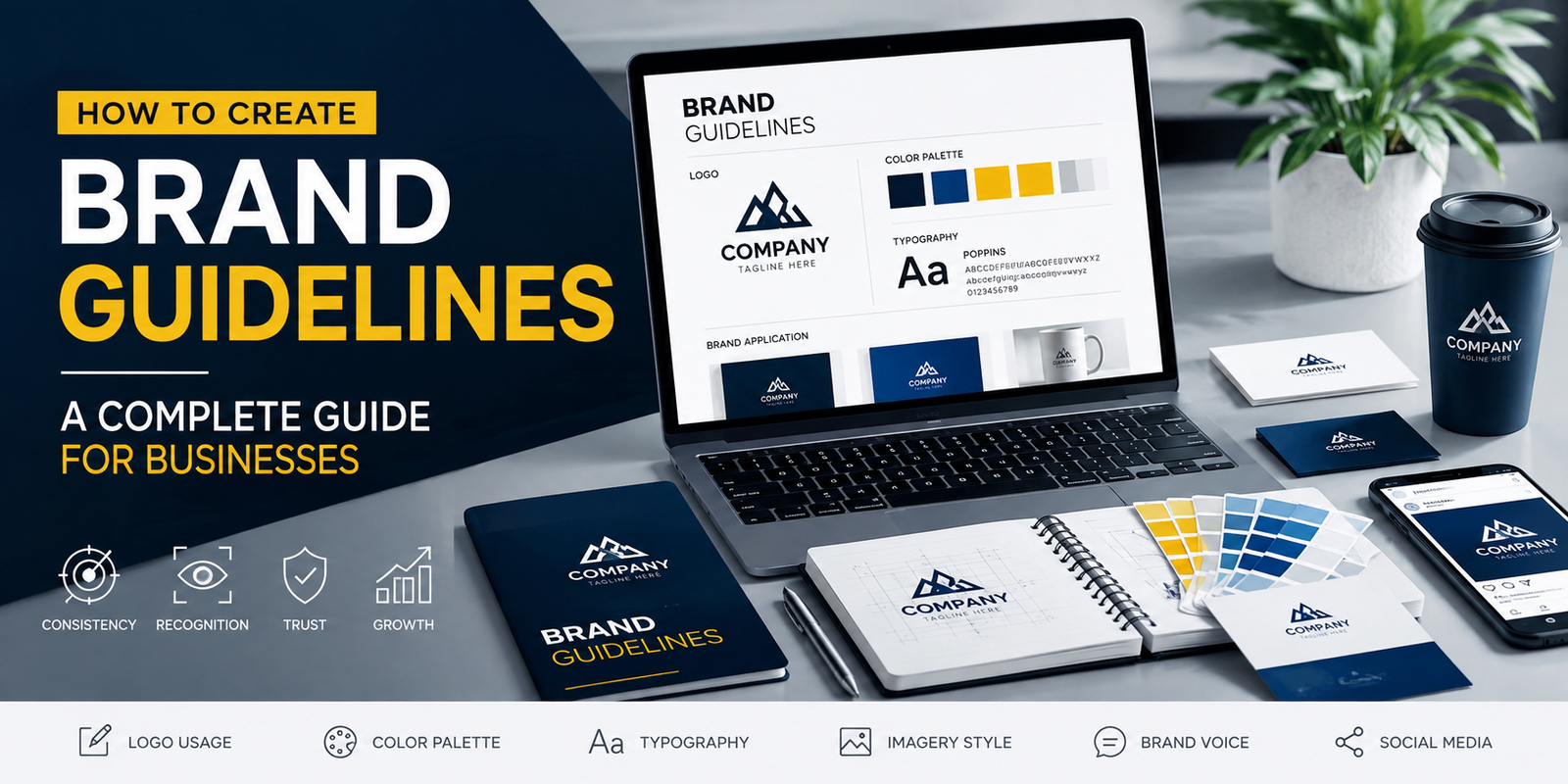
Create a premium 16:9 cinematic business branding workspace showing a laptop displaying a professional brand guideline document, a brand logo sheet, color swatches, typography samples, business cards, website mockup, social media posts, and marketing materials arranged on a modern desk. Clean corporate aesthetic, dark navy and blue with vibrant accent colors, realistic lighting, sophisticated digital marketing agency style, high-end professional presentation, no people, no text dominating the image.
